

Tennessee wrongful death law: 1-Year Critical Guide
Navigating Grief and Justice in Tennessee
Tennessee wrongful death law allows surviving family members to seek justice and financial compensation when a loved one dies due to another’s negligence, wrongful act, or omission. If you’re trying to understand your legal rights after losing someone, here’s what you need to know:
Quick Overview of Tennessee Wrongful Death Law:
- Who Can File: Surviving spouse, children, next of kin, or estate representative (in that order)
- Time Limit: One year from the date of the injury that caused death (not the date of death)
- What You Can Recover: Medical bills, funeral costs, lost income, pain and suffering, loss of companionship
- Proof Required: Show the death resulted from another party’s negligence or wrongful act
- Where to File: Tennessee civil court in the county where the death occurred or the defendant resides
Losing someone you love is devastating, and the pain is compounded when the loss was preventable. While no amount of money can bring back your loved one, wrongful death claims exist to hold negligent parties accountable and provide financial support for those left behind.
The legal process can feel overwhelming while you’re grieving. Medical bills, funeral expenses, and lost income create immediate financial pressure. This guide walks you through Tennessee wrongful death law in plain language, explaining who can file, what damages you can recover, and why the one-year deadline is so critical.
At Bill Easterly & Associates, we’ve stood beside Middle Tennessee families during their darkest hours for decades. We know the Nashville, Franklin, and Murfreesboro communities because we’re part of them. We offer free consultations with no upfront fees because every family deserves answers.
You’re not alone in this. Let’s walk through what Tennessee law says about wrongful death claims together.
What Constitutes a Wrongful Death in Tennessee?
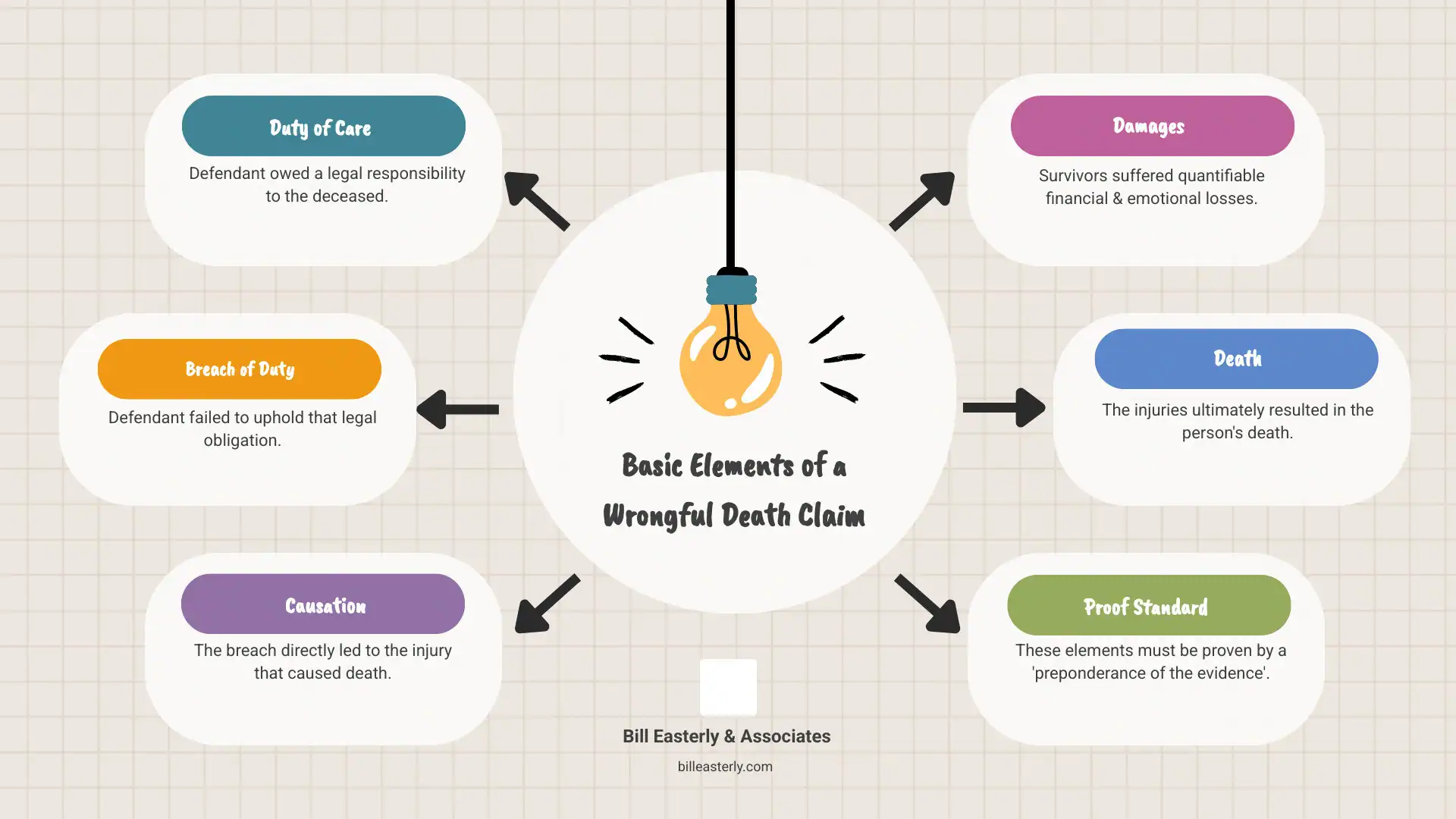
Under Tennessee law, a wrongful death occurs when someone dies due to the “wrongful act, fault, or omission of another.” Essentially, if the person had survived, they would have had grounds for a personal injury lawsuit. The key is that someone else’s actions—or failure to act—directly caused a preventable death.
Wrongful death cases are civil lawsuits, not criminal cases. A civil claim focuses on financial compensation for the family, while criminal charges aim to punish the offender. The burden of proof in a civil case is a “preponderance of the evidence,” meaning you must show it’s more than 50% likely the defendant was responsible. This is a lower standard than the “beyond a reasonable doubt” required in criminal trials, so you can win a wrongful death case even if no criminal charges are filed.

Common Causes of Wrongful Death
Wrongful deaths can result from many different tragic incidents across Middle Tennessee. Common causes include:
- Car and Truck Accidents: Negligent driving, such as texting, speeding, or driving under the influence, is a leading cause. The size and weight of commercial trucks often make these accidents fatal, caused by issues like driver fatigue or improper maintenance.
- Medical Malpractice: Fatal errors can include surgical mistakes, misdiagnosis, medication errors, or birth injuries when a healthcare professional fails to meet the standard of care.
- Defective Products: A faulty tire, a toxic children’s toy, or a malfunctioning medical device can kill without warning. Manufacturers have a duty to ensure their products are safe.
- Workplace Accidents: These often occur on construction sites or in industrial facilities due to inadequate safety equipment, poor training, or an employer prioritizing profit over safety. The tragic 16 Workers Killed in Tennessee Industrial Explosion is a devastating reminder.
Other causes include dangerous property conditions, nursing home neglect, and intentional acts of violence.
Proving Fault and Negligence
To win a wrongful death case, you must prove the defendant’s actions caused the death. This requires a thorough investigation and concrete evidence, such as:
- Police Reports and Accident Reconstruction: These documents and expert analyses determine factors like speed, impact, and driver behavior.
- Medical Records: They document the injuries and how they led to death. In malpractice cases, they show whether proper protocols were followed.
- Eyewitness Accounts: Testimony from people who saw what happened provides crucial details.
- Expert Witnesses: Specialists like medical experts, engineers, or financial analysts can explain complex information to a jury.
- Photos, Videos, and Other Documents: Surveillance footage, maintenance logs, or design documents can provide visual proof or reveal a pattern of neglect.
Proving fault means showing the defendant had a duty of care, breached that duty, the breach caused the death, and your family suffered damages as a result. Our team has decades of experience gathering this evidence to secure justice for Tennessee families.
The Tennessee Wrongful Death Lawsuit: Who, When, and How
Filing a wrongful death claim is a formal civil lawsuit with strict rules and deadlines. Understanding the process—who can file, when they must file, and what happens next—is crucial for protecting your family’s legal rights during an incredibly difficult time.

Who Has the Right to File a Claim Under Tennessee Wrongful Death Law?
Tennessee law establishes a specific order of priority for who can file a wrongful death lawsuit. The right belongs to:
- The surviving spouse.
- If no spouse, the surviving children. This includes biological and adopted children.
- If no spouse or children, the next of kin. This is typically the deceased’s parents.
- The personal representative of the estate if no family members above exist or are willing to file.
Importantly, any money recovered is protected from the deceased’s creditors and is intended for the surviving family members. Tennessee law also recognizes an unborn child as a “person” for these claims, allowing families to file a lawsuit for the loss of a baby at any stage of gestation. For complete details, see 2024 Tennessee Code :: Title 20 :: Chapter 5 :: Section 20-5-106.
The Critical One-Year Statute of Limitations
This is where many families unknowingly lose their rights. The deadline to file a wrongful death lawsuit in Tennessee is one of the most misunderstood aspects of the law.
The statute of limitations is typically one year from the date of the injury that caused the death, not from the date of death itself.
For example, if a person is injured in an accident on February 1st and passes away on April 1st, the deadline to file a lawsuit is likely February 1st of the following year. This harsh timeline catches many grieving families by surprise.
While there are narrow exceptions, such as the “findy rule” (if the cause of death couldn’t have been reasonably finded) or cases involving certain criminal acts, you should not rely on them. The safest course of action is to contact an attorney immediately to understand your specific deadline. We offer free consultations so you can get answers without financial risk.
The Step-by-Step Process of Filing a Lawsuit
While every case is different, a wrongful death lawsuit generally follows these steps:
- Initial Consultation: You meet with an attorney for a free, no-obligation case review to discuss what happened and learn your legal options.
- Investigation: If you move forward, your legal team gathers all necessary evidence, including police reports, medical records, and witness statements. They may hire experts to help establish fault.
- Filing the Complaint: Your attorney drafts and files a formal complaint in the appropriate Tennessee civil court, officially starting the lawsuit.
- Findy: Both sides exchange information through written questions (interrogatories), document requests, and depositions (formal interviews under oath). This phase helps both sides understand the case’s strengths and weaknesses.
- Negotiation and Mediation: The vast majority of cases are settled out of court. Your attorney will negotiate with the defendant’s legal team or insurance company to reach a fair settlement, sometimes with the help of a neutral mediator.
- Trial: If a fair settlement cannot be reached, the case proceeds to trial, where a judge or jury will hear the evidence and decide the outcome.
An experienced attorney handles these legal burdens so you can focus on your family. We work on a contingency fee basis, meaning no upfront fees—we only get paid if we recover compensation for you. For more on this process, see our Guide to the Personal Injury Claims Process.
Understanding Compensation: Damages in a Tennessee Wrongful Death Case
While no amount of money can replace your loved one, Tennessee wrongful death law allows families to recover compensation for the devastating financial and emotional consequences of their loss. These damages are meant to hold the responsible party accountable and provide the resources your family needs to move forward.

Wrongful Death Claims vs. Survival Actions in Tennessee
Tennessee law allows for two types of claims to be filed together after a death:
- A wrongful death claim compensates the surviving family members for their own losses, such as lost financial support and companionship.
- A survival action is brought on behalf of the deceased’s estate to recover damages the person could have claimed if they had survived. This includes their pain and suffering before death and medical bills.
In short, the wrongful death claim is for the family’s future losses, while the survival action is for the deceased’s losses before they passed away. You can find More info about Wrongful Death on our site.
Types of Recoverable Damages Under Tennessee Wrongful Death Law
Tennessee Code § 20-5-113 outlines the damages that can be recovered. These are intended to cover both the financial and human cost of the loss.
Damages for the Estate (Survival Action):
- Medical expenses incurred before death.
- Lost wages between the time of injury and death.
- The deceased’s physical and mental pain and suffering.
Damages for the Survivors (Wrongful Death Claim):
- Funeral and burial expenses.
- Lost future earnings and benefits the deceased would have provided.
- The pecuniary value of life, which includes the financial support and services the deceased contributed.
- Loss of consortium, which compensates for the loss of love, companionship, comfort, and guidance.
For the exact statutory language, you can consult 2024 Tennessee Code :: Title 20 :: Chapter 5 :: Section 20-5-113.
Punitive Damages and State-Mandated Caps
In cases of particularly reckless or malicious conduct, a court may award punitive damages. These are intended to punish the wrongdoer and deter similar behavior in the future.
However, Tennessee law places caps on certain damages. For most cases, non-economic damages (like loss of consortium) are capped at $750,000, though this cap can increase to $1,000,000 if the deceased left behind a minor child. Punitive damages are generally capped at $500,000 or twice the amount of compensatory damages, whichever is greater.
Navigating these caps to maximize your family’s recovery requires an experienced attorney. During your free consultation, we can explain what damages may apply to your specific situation.
Frequently Asked Questions about Tennessee Wrongful Death Law
When you’re grieving, legal questions can feel overwhelming. Here, we answer some of the most common questions we hear from families in Nashville, Franklin, and Murfreesboro to provide clarity during a difficult time.
How long do I have to file a wrongful death claim in Tennessee?
This is the most critical question. In Tennessee, you typically have one year from the date of the injury that caused the death to file a lawsuit, not one year from the date of death. For example, if your loved one was injured in a car accident on February 1st and passed away on April 15th, the deadline is likely February 1st of the next year.
This short window is one of the harshest aspects of Tennessee law. If you miss this deadline, you will almost certainly lose your right to pursue compensation. Because time is of the essence, we urge you to contact an attorney immediately. We offer free consultations so you can understand your options before it’s too late.
Can I still file a claim if my loved one was partially at fault?
Yes. Tennessee uses a “modified comparative fault” rule. Your family can still recover damages as long as your loved one was found to be 49% or less at fault for the incident. The total compensation award will simply be reduced by their percentage of fault.
For example, if a jury awards $1,000,000 but finds your loved one was 30% at fault, your family would receive $700,000. However, if your loved one is found to be 50% or more at fault, you are barred from recovering any damages. Insurance companies often try to shift blame to reduce their payout, which is why having an attorney to fight for a fair allocation of fault is crucial.
Do I really need a lawyer for a wrongful death claim?
While you can represent yourself, it is highly inadvisable. Wrongful death cases are legally complex, involving strict deadlines, evidence rules, and expert testimony. You will be up against insurance companies and their lawyers, whose goal is to pay as little as possible.
An experienced wrongful death attorney manages these legal burdens for you. We investigate the death, calculate the full value of your claim, handle all communication with the insurance company, and fight to ensure your family receives fair compensation. At Bill Easterly & Associates, we work on a contingency fee basis, so you pay no upfront fees, and we only get paid if we win your case. This allows you to focus on healing with your family. For more insight, read Do I Really Need a Lawyer to Help With My Personal Injury Claim?
Conclusion: Finding a Path Forward with Compassionate Legal Guidance
Losing a loved one due to someone else’s negligence leaves a hole that nothing can fill. The grief is overwhelming, and the financial pressures can arrive when you are least prepared.
While no lawsuit can erase your pain, Tennessee wrongful death law exists to provide a measure of justice and financial stability. It is about holding negligent parties accountable and securing your family’s future. This guide has outlined the key aspects of these claims, from what constitutes a wrongful death to the types of damages you can recover and the critical one-year statute of limitations from the date of injury.
The emotional weight of navigating this complex legal process alone is a burden no family should bear. Timely action is essential, as the law does not pause for grief.
At Bill Easterly & Associates, we have walked beside Tennessee families through their darkest moments for decades. We are your neighbors in Nashville, Franklin, and Murfreesboro, and we combine big-firm results with the personalized care you deserve. We handle the legal complexities so you can focus on healing, and we offer free consultations with no upfront fees because every family deserves access to experienced legal guidance.
If you are facing the devastating reality of a wrongful death, please know you are not alone. We are here to listen, answer your questions, and stand with you every step of the way.
Contact our compassionate attorneys for a free consultation today. Let us help you find a way forward.